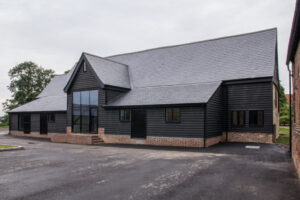
Is temporary agricultural workers’ accommodation for employees to use on an occasional basis during lambing and calving a dwelling that is liable for the Community Infrastructure Levy (CIL)? That is the question that was in front of the appointed person in a recent CIL appeal.
The Local Planning Authority (also the charging authority for CIL) granted retrospective planning consent for the “‘Erection of an agricultural building with ancillary staff welfare facilities and workshop”. The staff welfare facilities included a WC and shower, kitchen unit, refrigerator for veterinary products, log burning stove to provide sustainable heat and upper floors to provide sleeping areas. Condition 2 of the planning consent stipulated that the staff facilities cold only “‘be used for temporary overnight accommodation, between—— and—— each year and shall be limited to a person solely or mainly employed in the locality in agriculture. The building shall not be used for overnight accommodation outside this period.”
All CIL appeal decision are heavily redacted, but it is clear from the decision that the missing dates above were to coincide with the lambing and calving season.
The LPA then issued a CIL liability notice because it said that the staff facilities should be treated as a dwelling for the purposes of the CIL regulations and was accordingly liable to CIL. In a spirit of compromise, the appellant offered to pay a CIL charge of one third on the basis that the staff welfare facilities were available to be used for one third of the year. That offer was rejected by the LPA.
The case made on behalf of the appellant was that the staff welfare facilities were essential, temporary facilities for staff employed during lambing and calving. They said that they were ancillary to the primary, permitted agricultural use of the building with a condition of the planning permission – referred to above – restricting the use of the accommodation to four months of the year and only by people employed locally, in agriculture.
The LPA said that the term “residential dwelling” was not specifically defined within its CIL charging schedule and that it was not limited to being a C3 use as per the Use Classes in the Town and Country Planning (Use Classes) Order 1987 (as amended). As such it considered that the term of ‘residential dwelling’ for the purposes of the its charging schedule can be broader.
It also referred to case law and, in particular, the case of Grendon v First Secretary of State and another [2006] EWHC 1711 (which itself referred to Gravesham BC v Secretary of State for the Environment & anor. (1982) 47 P & CR 142), which set the legal test for a dwelling as a building whose defining characteristic is the ability to ‘afford to those who use it the facilities required for day to day private domestic existence’ which, in the LPA’s view was demonstrably the case.
In a decision informed strongly by common sense, the appointed person said:
“I consider there is a functional reason and purpose for the provision of the facilities which is integral, but ancillary to the primary use of the building, as a lambing/calving barn (agricultural use).
I do not agree with the CA that the facilities are akin to a dwelling with an agricultural occupancy restriction. A dwelling implies permanency and I question where the CA would expect the agricultural workers to live during the other eight months of each year, when the staff facilities can not be used.
With regard to whether the provision of such facilities can be considered to be a ‘residential dwelling’, I refer to The Collins English Dictionary which defines a ‘dwelling’ as ‘a place where someone lives’.
I consider the inclusion of Condition 2 (of the planning permission) evidences the Council’s clear intention to allow facilities to be provided, but NOT to create a new dwelling in the countryside.
I opine that the subject building is not suitable for use as a residential dwelling; permanent occupancy is prohibited by Condition 2 (attached to the planning permission) and I do not consider temporary, seasonal accommodation to offer sufficient permanence to be defined as a dwelling (where someone lives).”
Having so opined, the appeal was dismissed.